

Here’s a quick catch up:
ETF Nerd? I wrote about the state of innovation in ETFs, the challenges of 2026, and how we’re running the ETF.com 2025 awards this year.
World on fire? I also wrote a piece for Panoptica.ai, called “Tending the Wick.” It’s very short.
AI Stuff? I wrote a about my experiences working with Claude Code at ETF.com a few weeks ago: Code Life.
... this note is more about AI, but I want to get past the “how to” stuff and talk a bit about the “so what?” of it all.
Friction
My modern digital workplace has largely been taken over y “the internet.” And the ol’ “World Wide Web” has become a fundamentally adversarial, high friction place to work.
Two things got me to an “aha” moment about this.
The first is my friend Barry, who writes books. When Barry gets a big idea, he takes over an entire wall with Post-Its. For him, it’s the lowest-possible-friction way of getting things out of his head, and into the world. If he wants to see what deleting a chapter does to flow, he just moves a column of notes. New big idea? Ten new notes. Instant. No “click, click, file save.” No decisions. No “which version number is this.”
If I’m honest, my version of that system is making zines, but that’s not particularly useful for actual work, where the “artifacts” I’m creating aren’t usually paper and glue, but ideas, images, videos, data, analysis, schedules, and plans. But I used to be good at managing my digital life.
In the Beginning
The first computer I worked on was an Apple II, which lived in an attic room at school. No disk drives, just a cassette player and whatever you could type.

Pure simplicity. There’s no extra anything on this screen. There’s not even a “What would you like to do?” question mark. It is the blankest of blank slates.
The programs we ran came on cassette tapes or we typed in by hand, and were largely abstract. Star Trek anyone?
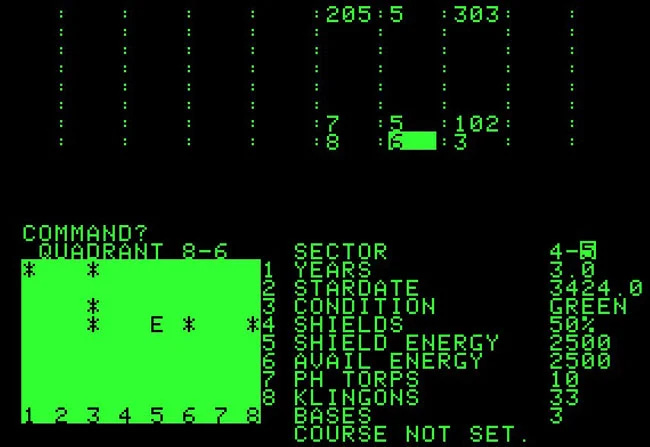
As a neurospicy pre-teen, it was utterly absorbing. There was only the one thing: the ASCII characters and the keyboard. There was an intentionality to interacting with early computers that required a kind of digital zen, a mindfulness of action. There was no banner ad or new feature to explore.
“When walking, just walk. When sitting, just sit. But whatever you do, don’t wobble.” — Yun-men
By the time we reached the mature Macintosh operating systems of the late 80s and early 90s, complexity and distraction were already becoming overwhelming.
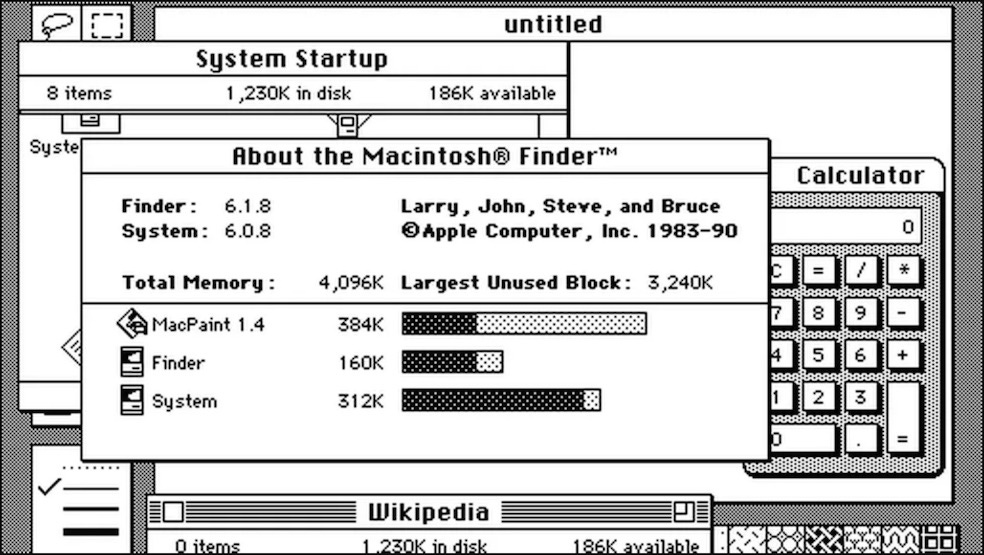
But in the proto-internet, even as the “desktop” became an un-asked-for and already-cluttered work-surface. I stayed firmly entrenched in ASCII text terminal screens, living on Bulletin Board Systems that gave me access to Usenet discussions, multi-user dungeons, and chat rooms. And at the San Francisco-based center of the BBS universe--The Whole Earth ‘Lectronic Link (the W.E.L.L.) -- I learned what I thought would be the foundational moderating principle for the internet.
”You Own Your Own Words” — YOYOW. What you contributed remained yours, but by the same token, you were accountable for your own words (and subject to banning, shame and humiliation for being a jerk.) Quaint, I know. But also: words - text on screens - was the whole universe.
Back to the Future
I’ve chosen a hard line with AI on this YOYOW issue: I don’t ever let it “write for me.” So, what does one do with AI if it’s not writing clickbait advertorials or bad rap lyrics or taking the clothes off celebrities? Help it recreate the text-on-screen universe.
Well, here’s my version:
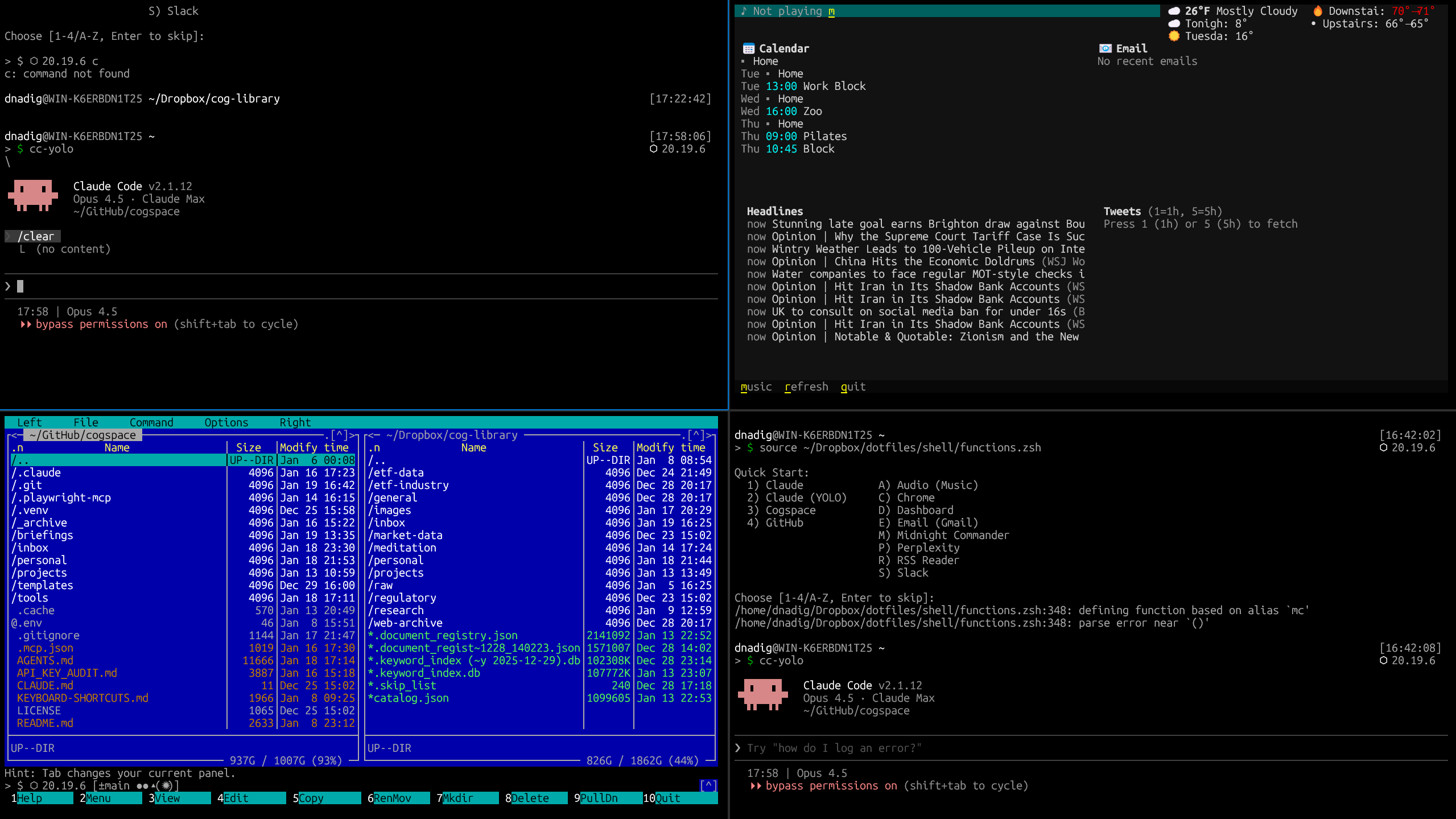
Just a bunch of terminal windows, a few Claude Code instances, and a bunch of very boring command line and terminal tools. And it’s been unbelievably great. It’s easier to show how I’m using Claude+Terminal tools than to try and put it on a page so:
I started by trying to take YOYOW to heart and clean up “my stuff” -- all the digital artifacts all over hard drives and web services and devices. Pictures, spreadsheets, PowerPoints, word documents, vague memories of where I published things a decade ago. And something just clicked. The friction went away. And every time I found a new friction point (like, say, data cleaning), Claude helped develop a process and tools so next time, there’s less friction.
Here’s how Claude Code/AI YouTube Guru Nate Jones put it recently (emphasis mine):
The web fights back. The web is adversarial because it needs to be from a security perspective. File system agents can be robust because your local machine is not adversarial. Your local machine is friendly. And so Anthropic’s bet is that long-term most valuable knowledge work ends up living in your files. It lives in your docs, your spreadsheets, your notes, your receipts, your recordings, stuff that gets on your hard drive or in your Google Docs. And that processing these artifacts is where the real productivity leverage sits long term.
When the bulk of work happens “online”, through web interfaces, we’re in a hostile environment. My “work surface,” isn’t mine. I have to accept all of Google or Microsoft or Adobe or Figma or Canva or Tableu’s idea about where a button should be, or what might be important, or worse, what someone is trying to sell me or get me to do. More often than not, what’s on my screen has been PUSHED at me, not PULLED by me.
Its friction. Endless, distracting, deliberately intrusive, nudging, agenda-containing sources of friction. By switching my “work surface” from “http://” to Claude Code, I’ve removed mountains of that friction, and every little speed bump I find, Claude helps me overcome in a way that is designed by me, for what my brain craves.
Simplicity.
Yes, the complexity of, say, the Adobe Premiere interface has a purpose.
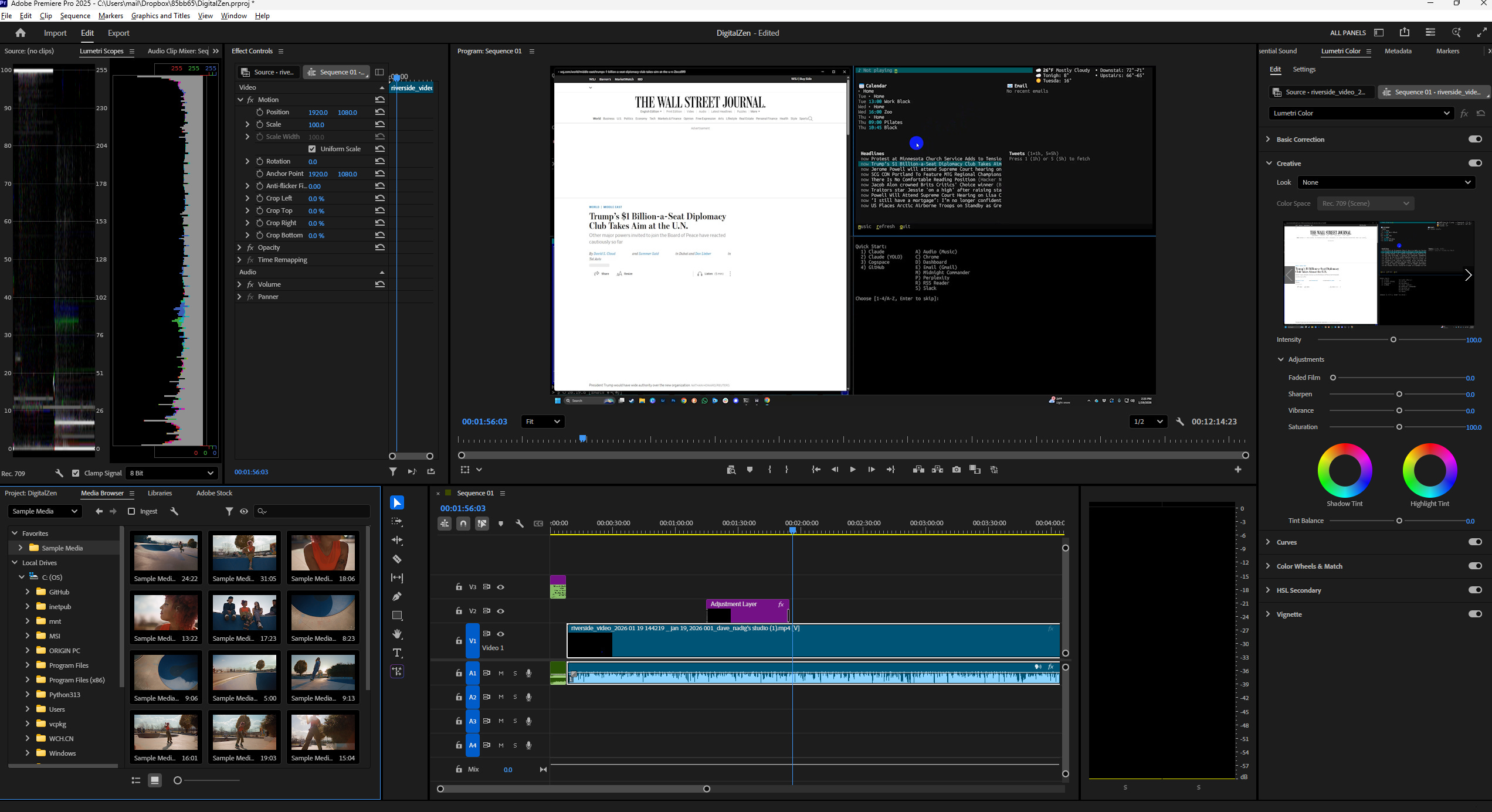
But it also presents quite literally hundreds of interaction points all at once. AI agents will rapidly make much of that complexity invisible, but only if the users are ready to start co-working with AI agents, instead of driving a buss with 1,000 switches.
Low Friction+Structure=#Winning
While removing friction sounds like a universally great idea, to really use an agent like Claude Code, I have to be able to assign it tasks — the things that had been slow, hard, or unsatisfying because of friction. I have to be able to articulate, with some detail, what I need done. Luckily, Claude Code is designed with this in mind, and is fantastic at iterating with me to create robust, long form definitions of tasks, whether the task is analyzing performance data, summarizing prospectus filings, or organizing recipes.
Our job, as the human in the loop, is to direct the agents and tools towards producing... something. A budget, a piece of code, a stats analysis, a document, a presentation, an image, a loaf of bread. Whatever the task is, the human value is in taking the unstructured mess that is human thinking and creativity and turning it into task definitions and artifacts that capture not only the creative spark, but the definition of “done”, the rubrics of quality and infusing subtlety and magic into the artifacts made.
I’ve chosen to die on the hill of owning my own words (and my own environment), so my “and thus” are these very words, not written by AI, but stored, managed, filed away, and published by AI. I’m doing the part I want to do. The part that (hopefully) I’m good at. And I’m not doing 90% of the cruft that used to get in the way, while having all that done better.
Feels like a win.
I do not use AI currently, I'm retired :-) Your articles on AI have really helped me understand how AI can be used to enhance a person's productivity. I'm glad you write your own words because you do it so eloquently. Before retiring, I taught programming, database and web development for 25 years. I wish I was just starting my teaching career now because AI would make teaching those subjects really exciting.